Animal nutrition education
Joint Support Supplements for Dogs: Wafers, Powders and Labels
Comparing joint support supplements for dogs means looking beyond the words hip, joint or mobility. A wafer with declared glucosamine and chondroitin differs from a complex musculoskeletal powder. Start with your dog’s veterinary assessment, then compare the exact ingredients, manufacturer weight schedule and practical administration requirements of each option.
Explore Animal Health →
Separate a mobility observation from its cause
Write down what you have noticed: a different walking routine, hesitation on steps or another change in movement. Those observations can help your veterinarian, but they do not establish why the change occurred. Choosing a joint supplement should not become a substitute for assessing new discomfort or a loss of function. Record when the change started and which activities bring it out. Keep the shopping question separate from the clinical question your veterinarian needs to answer.
Compare declared ingredients rather than front-label promises
Two products can share a joint-support category and still have very different compositions. Look for the ingredient identity, amount, serving unit and whether quantities describe a minimum guaranteed amount or a proprietary blend. A larger blend total does not reveal the amount of every ingredient inside it. Research about one preparation should not be treated as proof that a different finished formula produces the same result. Use those distinctions to ask more focused questions.
Compare Standard Process mobility formulas
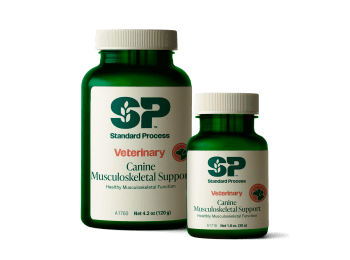
Canine Flex Support and Canine Musculoskeletal Support illustrate a wafer and a powder approach. Their compositions and directions are distinct. The complete panels below preserve their existing recorded ingredients and cautions, while the individual pages retain package details and direct purchase destinations. Comparing the two does not mean they should be combined or that either is the right choice for every older dog. Your veterinarian can help connect a specific nutrition question to the appropriate label.
| Product | Listing focus | Declared formula in brief | Label directions |
|---|---|---|---|
| Canine Flex SupportView product →Standard Process Veterinary Formulas | Helps maintain healthy joint function | Per wafer: glucosamine sulfate (from shellfish) minimum 250 mg, chondroitin minimum 110 mg, vitamin C minimum 5 mg and vitamin E minimum 5 IU. | Manufacturer daily schedule for dogs: 1–25 lb, 1 wafer; 26–50 lb, 2 wafers; 51–80 lb, 3 wafers; over 80 lb, 4 wafers, or as otherwise directed. Confirm the current package and your veterinarian’s directions.Full ingredients and cautions → |
| Canine Musculoskeletal SupportView product →Standard Process Veterinary Formulas | Supports optimal musculoskeletal function | Per ¼ tsp (600 mg): boswellia extract 191 mg, green mussel (shellfish) 161 mg, manganese 0.18 mg and a 245 mg proprietary blend. | Manufacturer daily schedule for dogs: 1–10 lb, ¼ tsp once daily; 11–20 lb, ¼ tsp twice daily; 21–40 lb, ½ tsp twice daily; 41–60 lb, 1 tsp twice daily; 61–80 lb, 1½ tsp twice daily; over 80 lb, 2 tsp twice daily, or as otherwise…Full ingredients and cautions → |

Canine Flex Support
The recorded wafer declares glucosamine sulfate from shellfish and chondroitin, with a manufacturer daily weight schedule. Compare that format and complete ingredient list with dietary restrictions and the veterinary plan. It is not presented as proven pain treatment.
View complete ingredients, cautions and sizes →Buy Canine Flex Support through WSNC inSITE ↗Canine Musculoskeletal Support
This powder uses a different complex blend, including recorded boswellia and green mussel ingredients. A blend total should not be interpreted as the amount of each component. Read its own directions and cautions rather than transferring the wafer schedule.
View complete ingredients, cautions and sizes →Buy Canine Musculoskeletal Support through WSNC inSITE ↗Read the wafer amount and daily weight schedule separately
Canine Flex Support’s recorded panel declares glucosamine sulfate and chondroitin per wafer. Its daily directions use dog-weight bands. A per-wafer declaration is not the same thing as a daily amount for every dog. Keep the two statements together on your comparison sheet and follow the exact manufacturer instructions or veterinary directions. Do not infer a new schedule from the size of the dog next door or from the directions for another joint product.
Check the powder’s measuring instructions and complete blend
A powder requires its own package-specific measurement and administration review. Do not substitute a scoop from another bottle or assume a teaspoon amount from one formula carries over to another. A complex musculoskeletal blend also contains more than its highlighted ingredient. Review the entire list, tissue ingredients and shellfish sources where present. This helps distinguish an ingredient comparison from an instruction to use a product, and avoids treating different preparations as equivalent by category alone.
Plan for the routine you can maintain
Ask how the product would be given alongside the existing food and other care. A convenient format matters, but convenience does not establish suitability. Record what happens if a wafer is refused, part of a meal is left behind or the measuring instruction is unclear, and obtain veterinary guidance rather than improvising. Keep all products in their labeled containers and maintain a simple list of what is actually given. That makes a later review more useful.
Prepare a mobility review with your veterinarian
Bring the product labels, current weight, medicines, other supplements and a short description of the change in activity. Ask what each proposed formula would contribute and whether it overlaps another product. Discuss how the overall care plan will be reviewed rather than expecting a guaranteed response by a fixed date. Supplements are one shopping category; diagnosis, pain management, activity advice and other clinical decisions belong with the veterinarian who knows your dog.
References: FDA: animal health and veterinary care
Questions pet owners ask
What is the best joint supplement for every dog?
This comparison cannot establish a universal best. The mobility question, exact formula, other care and individual suitability determine what is worth discussing.
Are wafers and powders interchangeable?
No. Compare their complete ingredients, declared amounts and individual manufacturer schedules rather than converting between formats by volume or weight.
Does a joint label mean my dog has arthritis?
No. A product category cannot diagnose the cause of a movement change. Arrange veterinary assessment for new or worsening signs.
Can I combine the two formulas?
They are shown as alternatives to investigate, not a suggested combination. Ask your veterinarian to review overlap and purpose.
How soon should I expect results?
This guide does not promise a response or set a treatment timeline. Agree on an individualized review plan with your veterinarian.
Evidence and product information sources
- FDA: animal food and supplement categories ↗
- FDA: animal health and veterinary care ↗
- Canine Flex Support authorized product information ↗
- Canine Musculoskeletal Support authorized product information ↗
Animal guides explain label comparisons and questions for a veterinarian. They do not replace veterinary diagnosis, treatment or an individualized diet review.
Educational references explain nutrition and evidence limits; they do not endorse WSNC or the products shown. Product comparisons use the existing catalog records. Confirm the current manufacturer label, selected package, complete directions and cautions before ordering.
Return to the species collection →