Animal nutrition education
Older Dog Mobility in Winter: Routine and Supplement Questions
Colder weather can change an older dog’s daily routine, but the season alone does not explain a movement change or establish a need for a supplement. Use a winter review to describe what is different, check an existing care plan and compare a proposed formula carefully. Keep the practical routine and the clinical question connected without treating them as the same decision.
Explore Animal Health →
Describe the winter routine rather than assuming a cause
Write down changes in time outdoors, walking arrangements, surfaces and ordinary daily activity. Then describe any change in movement separately. A coincidence with cold weather does not establish why the dog is moving differently. Your veterinarian can assess whether a new concern needs examination and what advice fits the individual dog. A seasonal supplement guide should organize the discussion, not diagnose winter stiffness or assign a product before the concern is understood.
Review the existing care plan before adding a bottle
List prescribed care, food, medicines and all products currently given. Ask what should remain consistent during the change of season and whether any part of the plan needs review. An older dog can have several concerns, but that does not mean each requires another supplement. If a proposed formula has no clear purpose within the plan, keep it as a question. Do not replace prescribed management because a winter advertisement highlights mobility or natural ingredients.
Compare Standard Process mobility formats
Canine Flex Support and Canine Musculoskeletal Support provide the same focused formula comparison used in the main dog-joint guide. Here the question is whether the established or proposed format fits a winter routine and care plan. They are not a seasonal stack. The complete panels preserve recorded ingredients and directions, while the individual product pages retain package information. Use the main comparison for ingredient distinctions and this page for practical seasonal preparation.
| Product | Listing focus | Declared formula in brief | Label directions |
|---|---|---|---|
| Canine Flex SupportView product →Standard Process Veterinary Formulas | Helps maintain healthy joint function | Per wafer: glucosamine sulfate (from shellfish) minimum 250 mg, chondroitin minimum 110 mg, vitamin C minimum 5 mg and vitamin E minimum 5 IU. | Manufacturer daily schedule for dogs: 1–25 lb, 1 wafer; 26–50 lb, 2 wafers; 51–80 lb, 3 wafers; over 80 lb, 4 wafers, or as otherwise directed. Confirm the current package and your veterinarian’s directions.Full ingredients and cautions → |
| Canine Musculoskeletal SupportView product →Standard Process Veterinary Formulas | Supports optimal musculoskeletal function | Per ¼ tsp (600 mg): boswellia extract 191 mg, green mussel (shellfish) 161 mg, manganese 0.18 mg and a 245 mg proprietary blend. | Manufacturer daily schedule for dogs: 1–10 lb, ¼ tsp once daily; 11–20 lb, ¼ tsp twice daily; 21–40 lb, ½ tsp twice daily; 41–60 lb, 1 tsp twice daily; 61–80 lb, 1½ tsp twice daily; over 80 lb, 2 tsp twice daily, or as otherwise…Full ingredients and cautions → |
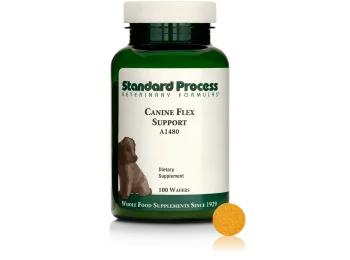
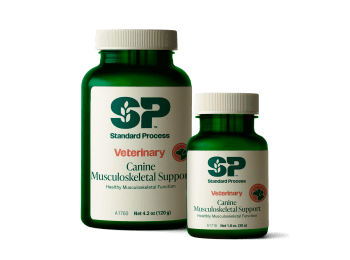
Canine Flex Support
A wafer mobility formula with declared joint-related ingredients and a daily dog-weight schedule. Winter does not create a separate higher schedule. Review the existing instructions and the dog’s actual care plan.
View complete ingredients, cautions and sizes →Buy Canine Flex Support through WSNC inSITE ↗Canine Musculoskeletal Support
A powder with a different complex formula and measuring instructions. Its format may raise practical questions for feeding or travel, but convenience does not establish clinical suitability or equivalence with a wafer.
View complete ingredients, cautions and sizes →Buy Canine Musculoskeletal Support through WSNC inSITE ↗Keep weight schedules current and units unchanged
Bring the dog’s current weight to the veterinary review and use the exact manufacturer schedule or individualized directions. Do not increase a product because the weather is colder or the dog seems less active. Wafer declarations, powder serving measures and daily schedules need to remain distinct. A scoop belongs with its own package instructions. For an unlisted weight or uncertain amount, ask rather than interpolating from another product’s schedule or a previous dog’s routine.
Ask about a practical daily plan
Discuss the actual home and outdoor routine with the veterinarian, including which observations matter and how to adapt the plan appropriately. This guide does not prescribe an exercise program or establish that a supplement resolves difficulty on a particular surface. The useful outcome is a plan that caregivers can follow consistently and review. Product format can be one practical consideration, but it should not displace the broader discussion about the dog’s function and comfort.
Prepare for travel and changes in caregivers
Winter visits and holiday travel can put an established routine in someone else’s hands. Retain the exact product label, measuring tool, written directions and contact information. Do not ask another caregiver to choose between similar joint formulas or decide whether an extra amount is needed. Check the package’s storage instructions for the whole journey, including any time in a vehicle. If instructions cannot be maintained, seek product-specific advice before making an improvised change.
References: FDA: animal health and veterinary care
Prepare a factual seasonal follow-up
Record what changed in the routine, which instructions were actually followed and any new concerns. Avoid attributing every improvement or setback to one product when several circumstances changed together. Ask the veterinarian how the overall plan should be reviewed and when to contact the practice. This guide promises neither a fixed response time nor prevention of age-related disease. New or worsening movement concerns should be assessed rather than managed by repeatedly increasing a winter supplement.
References: FDA: animal health and veterinary care
Questions pet owners ask
Does cold weather prove my dog needs joint supplements?
No. The season does not identify the cause of a movement change or establish the need for a particular product.
Should the amount change in winter?
Do not invent a seasonal increase. Follow the exact manufacturer or individualized veterinary directions.
Is this different from the main joint guide?
The main guide compares formula types and label declarations. This page focuses on winter routines, caregiver handoffs and review questions.
Can a supplement replace a mobility assessment?
No. New or worsening concerns belong with veterinary assessment and the individual care plan.
Can I combine wafer and powder for cold days?
No combination is recommended here. Ask the veterinarian to assess purpose and overlap before adding another formula.
Evidence and product information sources
- FDA: animal food and supplement categories ↗
- FDA: animal health and veterinary care ↗
- Canine Flex Support authorized product information ↗
- Canine Musculoskeletal Support authorized product information ↗
Animal guides explain label comparisons and questions for a veterinarian. They do not replace veterinary diagnosis, treatment or an individualized diet review.
Educational references explain nutrition and evidence limits; they do not endorse WSNC or the products shown. Product comparisons use the existing catalog records. Confirm the current manufacturer label, selected package, complete directions and cautions before ordering.
Return to the species collection →