Animal nutrition education
Whole Food Supplements for Horses: Purpose, Feed and Formula Labels
Whole food supplements for horses should be compared within the whole feeding and veterinary plan. A digestive powder, a mobility blend and a metabolic-support formula have different compositions and purposes, even when each uses a quarter-cup measure. Start with the question you are trying to answer, then read the exact equine label rather than choosing by the longest ingredient list.
Explore Animal Health →
Begin with the whole feeding record
List the forage, feeds, treats, supplements and medicines the horse actually receives. Include the exact product names, ordinary instructions and who is responsible for feeding. That record gives a veterinarian or qualified equine nutrition professional a useful starting point for a diet discussion. A targeted supplement does not establish that the overall ration is appropriate or replace assessment of an unbalanced feeding plan.
Keep the proposed product separate from the existing routine on the worksheet. Ask what it would add and which part of the nutrition question it is intended to address. If the purpose is unclear, preserve it as a question rather than assuming a broader blend will cover every possibility. The goal is an understandable plan, not a growing collection of overlapping powders.
Read whole food as an ingredient approach
Whole food wording does not establish that the entire formula is a whole food, that the product is a complete ration or that it is suitable for every horse. Read the actual ingredients, intended species and directions. A blend may combine food ingredients with extracts, isolated nutrients or other components. These distinctions matter independently of the appealing language on the front label.
Do not transfer assumptions from the human supplement market to an equine product. FDA distinguishes animal products from the special human dietary supplement category. This guide uses supplement as a familiar shopping term, while keeping the exact animal formula and its intended use central. No product name or category establishes a clinical outcome for an individual horse.
Separate digestive, mobility and metabolic questions
Organize the comparison around one defined purpose at a time. A gastrointestinal formula, a joint-support blend and a metabolic-support product are different discussions. The fact that a horse could have more than one concern does not establish a reason to combine all three. Keep the diagnosis and management of any condition with the veterinarian rather than deriving them from a product category.
Write down the reason for considering each formula and the information needed to assess it. A shared ingredient does not establish equivalence, and a different name does not prove there is no overlap. Review the full compositions together if more than one product is being considered. Avoid treating a category page as a ready-made feeding program.
Compare Standard Process equine examples
Equine GI Support, Equine Mobility Support and Equine Metabolic Support provide three distinct examples from the existing WSNC catalog. The complete recorded panels below allow a comparison of formula purpose, ingredients, directions and cautions. They are alternatives to investigate according to the actual question, not a three-product recommendation for every horse.
Use the individual product pages for their complete package information and direct authorized WSNC inSITE purchase destinations. The separate digestive, joint and metabolic guides explore narrower questions. A useful overview should help you choose the right next page or veterinary question; it should not collapse all three products into a general claim that a larger supplement routine is better.
| Product | Listing focus | Declared formula in brief | Label directions |
|---|---|---|---|
| Equine GI SupportView product →Standard Process Veterinary Formulas | Antioxidant support for GI health | The ¼-cup (30 g) serving includes whey protein (milk), flax meal, L-glutamine, inulin from chicory root, rice protein, vegetables and other ingredients. No probiotic CFU amount is declared. | ¼ cup (30 g) per 1,000 lb. horse per day, or as directed. 28-day supply.Full ingredients and cautions → |
| Equine Mobility SupportView product →Standard Process Veterinary Formulas | Promotes healthy joint function and mobility | The ¼-cup (33 g) blend includes flax meal, glucosamine hydrochloride, ginger, chondroitin sulfate, wheat germ oil, honey and cinnamon. Individual glucosamine and chondroitin amounts are not declared. | Administer orally. Includes ¼ cup scoop. Give ¼ cup (33 g) per 1,000 lb. horse per day.Full ingredients and cautions → |
| Equine Metabolic SupportView product →Standard Process Veterinary Formulas | Healthy glucose metabolism | The ¼-cup (37 g) proprietary blend contains buckwheat flour, carrot, cinnamon, licorice, green tea extract, cayenne, chromium yeast and vanadium chelate. | Administer orally. Includes ¼ cup scoop. Give 1/4 cup (37 g) per 1,000 lb. horse per day, or as directed.Full ingredients and cautions → |
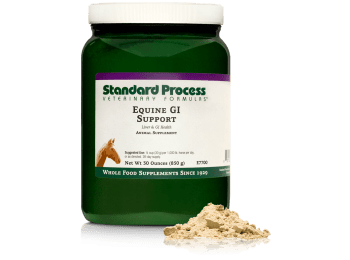
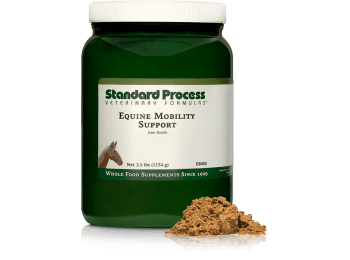
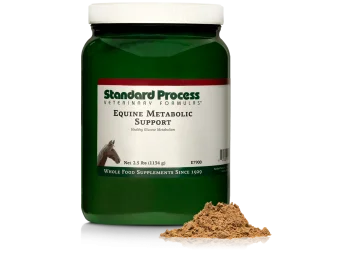
Equine GI Support
A gastrointestinal blend with recorded inulin and other ingredients. Its quarter-cup serving and 30 g declaration belong to this formula; they do not disclose the individual amount of inulin or make it equivalent to another equine powder.
View complete ingredients, cautions and sizes →Buy Equine GI Support through WSNC inSITE ↗Equine Mobility Support
A joint and mobility blend whose recorded quarter-cup serving weighs 33 g. Compare its full composition and cautions rather than transferring the gram amount or purpose of a digestive formula.
View complete ingredients, cautions and sizes →Buy Equine Mobility Support through WSNC inSITE ↗Equine Metabolic Support
A distinct metabolic-support blend with a recorded 37 g quarter-cup serving. Its name does not establish a diagnosis or replace an individualized feeding and veterinary plan.
View complete ingredients, cautions and sizes →Buy Equine Metabolic Support through WSNC inSITE ↗Keep scoop volume and serving weight distinct
A quarter-cup measure is a volume, not a universal powder weight. The existing records use different gram amounts for different equine formulas. Retain the exact product’s measure, gram declaration, frequency and horse-weight basis when comparing. Do not assume that the same-looking scoop makes two formulas interchangeable or gives the same amount of each ingredient.
Use the measuring instructions for the selected package and do not transfer a scoop from another container without checking. If a horse’s weight, an instruction or a measuring tool raises uncertainty, ask the veterinarian or manufacturer rather than extending a schedule by arithmetic. This guide explains label distinctions; it does not create a new individualized feeding amount.
Check the whole blend and the practical routine
Review milk, grain, botanical and other ingredients where present, alongside any individual feeding restrictions. A proprietary blend total does not disclose the amount of each component. If an amount is needed for a diet review and is not declared, ask the manufacturer rather than inferring it from the order of ingredients. Natural wording does not answer every suitability question.
Then ask whether the routine can follow the exact preparation and storage instructions. Identify who measures the powder, where the container is kept and how instructions will reach another caregiver. Do not assume every preparation or travel condition is appropriate. Keep the label accessible so that a product question can be resolved using the exact formula and package.
Prepare a veterinary and competition review
Bring the complete feeding record, proposed formula, medicines and the question you want answered. Ask what the product would contribute, whether it overlaps an existing item and how the overall plan should be reviewed. New illness or a concerning change in function requires veterinary assessment rather than an automatic increase in a powder.
For a horse competing under organizational rules, retain the manufacturer’s caution to check the relevant governing body about ingredients that could be controlled. Nutritional support wording does not establish competition clearance. The exact product, current rules and individual circumstances need their own review; this shopping guide supplies no blanket eligibility assurance.
References: FDA: animal health and veterinary care
Questions horse owners ask
Does every horse need a supplement?
No universal need is established here. Begin with the actual feeding plan and a defined nutrition question rather than treating an equine category as a mandatory routine.
Does whole food mean a complete ration?
No. A targeted blend does not establish the adequacy of the entire diet. Review the feeding plan with the appropriate equine professionals.
Are all quarter-cup scoops equivalent?
The volume wording does not establish identical gram weights or ingredients. Retain the exact product’s measure and serving declaration.
Can these three examples be combined?
They illustrate different purposes, not a suggested stack. Ask the veterinarian to assess the need, full ingredients and overlap.
Are these products automatically competition-approved?
No blanket clearance is established. Check the exact formula against the current rules of the relevant governing organization.
Evidence and product information sources
- FDA: animal food and supplement categories ↗
- FDA: animal health and veterinary care ↗
- Equine GI Support authorized product information ↗
- Equine Mobility Support authorized product information ↗
- Equine Metabolic Support authorized product information ↗
Animal guides explain label comparisons and questions for a veterinarian. They do not replace veterinary diagnosis, treatment or an individualized diet review.
Educational references explain nutrition and evidence limits; they do not endorse WSNC or the products shown. Product comparisons use the existing catalog records. Confirm the current manufacturer label, selected package, complete directions and cautions before ordering.
Return to the species collection →